
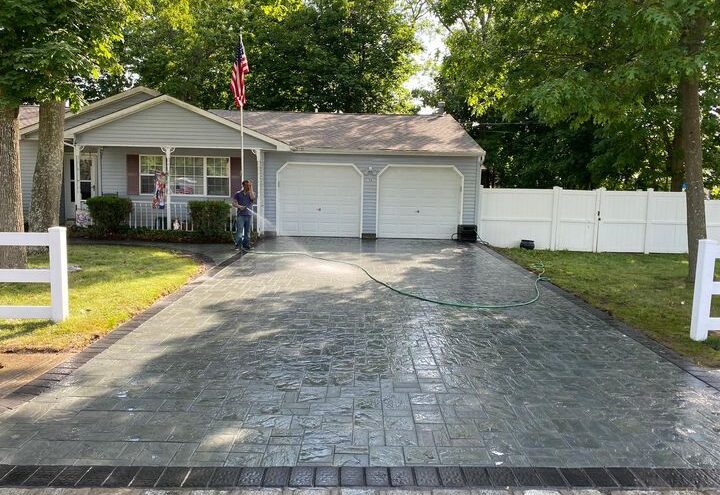
If you live in Long Island, you already know the truth: your driveway is not just “where the car goes.” It’s the first thing people see, and it has to survive real weather. Hot summers. Coastal moisture. Winter freeze and thaw. De-icing salt. Heavy SUVs. Delivery trucks.
That’s why many Nassau and Suffolk County homeowners consider a concrete paver driveway when their current driveway starts cracking, sinking, or just looks tired. Armorproof Paving & Masonry serves Long Island with driveway paving options including asphalt, interlocking stone pavers, and concrete, so homeowners can pick what fits their budget and style.
This guide breaks down cost, the real pros and cons, and what to ask Concrete Paver Installers Long Island before you commit.
What is a concrete paver driveway?
A concrete paver driveway is built with individual concrete blocks (pavers) laid in a pattern over a properly prepared base. The pavers interlock and the joints are filled with sand (often polymeric sand) to help lock them in.
Instead of one giant slab, you get a surface made of many units. That matters because Long Island’s freeze-thaw cycles can be rough on single-piece surfaces that crack and spread. With pavers, small movement is normal and repairs are often localized.
Concrete paver driveway cost in Long Island (what most homeowners can expect)
Let’s talk numbers, because that’s usually the first question.
Armorproof’s own Long Island paver guide lists concrete pavers at $8–$15 per square foot on average. (Other paver materials like brick and natural stone can run higher, but we’ll stay focused on concrete.)
A simple cost example
A common two-car driveway might be about 20 ft x 40 ft = 800 sq ft.
- Low end: 800 × $8 = $6,400
- Mid range: 800 × $11.50 = $9,200
- High end: 800 × $15 = $12,000
What pushes the price up (or down)
A concrete paver driveway quote is not just “pavers + labor.” The big cost drivers are:
- Removal of old asphalt/concrete
- How much excavation is needed
- Base depth and compaction (this is huge for long-term performance)
- Drainage fixes (regrading, channel drains, runoff direction)
- Borders and details (Belgian blocks, soldier course borders, apron work)
- Driveway shape (curves, slopes, tight spaces)
Armorproof lists related services like site excavation, driveway aprons, Belgian blocks, and masonry drainage, which are often the “hidden” parts of a driveway project that make the final result feel solid and look finished.
Pros of a concrete paver driveway
1) Looks high-end without feeling “too fancy”
Concrete pavers give you design flexibility: patterns, borders, and colors that can match your home (from classic colonials to modern builds).
2) Repairs can be simpler (and less ugly)
If a section settles or gets stained, pavers can often be lifted and re-laid. You’re not forced into a big patch that never matches.
3) Strong long-term durability when installed right
Armorproof’s paver article notes that pavers can last 30–40 years when properly installed (compared to asphalt that can start breaking down earlier). Real-life lifespan depends heavily on the base and drainage, but the point is: pavers are built for the long game.
4) Better performance through freeze-thaw than a single slab
Pavers are designed as an interlocking system. Minor movement does not automatically mean cracking the way it can with a single concrete pour.
5) Curb appeal upgrade that you feel every day
A driveway is something you use daily. When it’s smooth, clean, and even, it makes arriving home feel better (and it makes the whole property look cared for).
Cons (and honest trade-offs) to consider
1) Higher upfront cost than asphalt
A paver driveway is usually a bigger investment upfront than asphalt. The payoff is longevity and appearance, but budget matters.
2) Base prep mistakes show up later
The most common paver problems (sinking, shifting, puddles) usually trace back to poor base compaction or rushed prep. This is why installer quality matters more than the paver brand.
3) Weeds can happen if joints are ignored
If joint sand washes out, weeds can move in. Not every driveway becomes a “weed garden,” but you do need basic upkeep.
4) Snow removal needs a little care
If you plow, a metal blade can catch edges if the surface is uneven. Many homeowners use careful shovel technique, a snow blower, or a plow setting that avoids scraping too aggressively.
What a quality paver driveway installation should include
If you are comparing Concrete Paver Installers Long Island, don’t just compare price. Compare process.
Here’s a simple “healthy driveway” checklist:
- Design and layout
Pattern, border, slope direction, and where water should go. - Excavation
Removing the old driveway and digging to the correct depth (not “just enough to fit pavers”). - Base installation and compaction
A proper base is layered and compacted. This is where long-term stability comes from. - Edge restraints
These hold the field of pavers in place so they don’t spread over time. - Bedding sand + pavers
Pavers are set evenly and cut cleanly along edges. - Joint sand and final compaction
Sand fills joints and helps lock the system. Many contractors recommend polymeric sand to reduce washout and weeds. - Drainage check and finishing details
This is where aprons, borders, and transitions (to garage, sidewalk, or street) matter.
Armorproof emphasizes driveway solutions built to handle tough weather and daily use across Long Island, which is exactly what good base prep and drainage design are meant to do.
Maintenance: keep it looking new without making it a “project”
The goal is simple: protect the joints, keep it clean, and handle small issues before they become big ones.
Easy routine:
- Sweep and rinse when needed (especially after storms)
- Clean oil spots sooner rather than later
- Refill joints if sand is low
- Fix a settling area early (it’s usually easier when it’s small)
Resealing schedule (simple guideline)
Armorproof’s resealing guidance recommends resealing pavers and stonework about every 2–4 years, depending on traffic and exposure. Sealing can help with color, stain resistance, and moisture protection.
Signs it may be time:
- Color looks dull or faded
- Joints are losing sand
- Water doesn’t bead the way it used to
- Stains are soaking in faster
Quick FAQs
Is a concrete paver driveway worth it in Long Island?
If you care about curb appeal, want easier spot-repairs, and plan to stay in your home for years, many homeowners find the value is there. If you want the lowest upfront cost, asphalt may be the better fit.
Can pavers handle heavy vehicles?
Yes, when the base is designed for it. If you park heavier vehicles (work van, pickup, frequent deliveries), tell your installer so they plan base depth accordingly.
Do pavers get slippery?
Most concrete pavers have texture and joints that provide grip. The bigger issue is ice, which comes down to drainage and proper slope.
Final thoughts (and next step)
A concrete paver driveway is one of those upgrades that you see and feel every day. It can make your home look sharper, reduce the “crack and patch” cycle, and hold up well in Long Island’s weather when the installation is done right.
If you are looking for Concrete Paver Installers Long Island, Armorproof Paving & Masonry is based in Ronkonkoma and serves Nassau and Suffolk County with driveway paving options including pavers, asphalt, and concrete, plus related services like excavation and drainage.
They also offer free estimates and 24/7 phone availability for inquiries.