
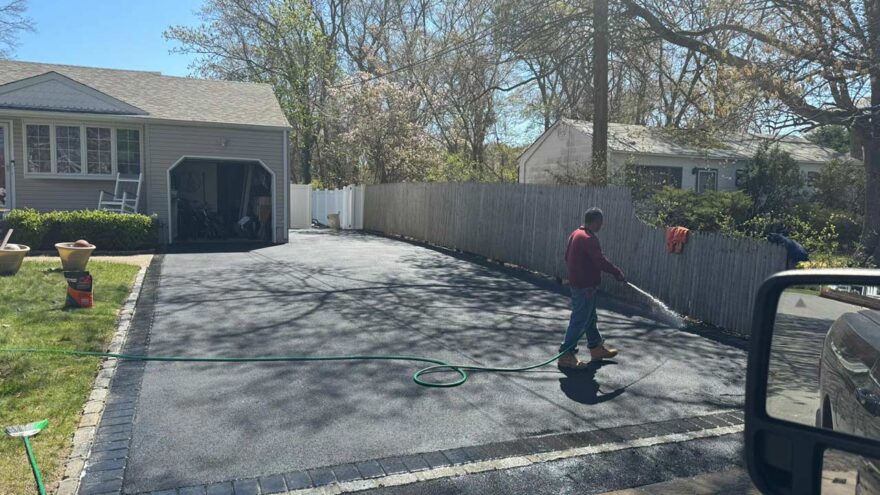
When your driveway starts looking faded, rough, or cracky, it’s easy to feel stuck between two extremes:
- “Let’s just seal it and move on.”
- “We probably need to replace the whole thing.”
If you’re in Long Island, NY, that decision matters even more. Freeze-thaw cycles, coastal moisture, and winter salt can speed up surface wear. The good news: you don’t always need a replacement. And the honest answer is usually this:
Driveway sealing saves more money when the driveway is structurally sound. Replacement saves more money when the base is failing.
Let’s break it down in a clear, homeowner-friendly way—costs, real-life examples, and a simple checklist you can use before calling anyone.
First: what “driveway sealing” actually does (and what it doesn’t)
Most people in Long Island mean asphalt sealcoating when they say driveway sealing: a protective coating applied to the surface to reduce water penetration, slow oxidation (sun/air damage), and improve appearance.
Sealing helps with:
-
- Faded, grey, “dry-looking” asphalt
- Small surface cracks (after crack filling)
- Minor surface wear and light raveling (loose grit)
- Preventing water intrusion that worsens freeze-thaw damage
Sealing does NOT fix:
- Deep potholes
- Base failure (soft spots that keep sinking)
- Widespread alligator cracking (web-like cracking)
- Drainage issues that leave standing water
Think of sealing like sunscreen + a rain jacket for your driveway. It protects what’s still healthy. It can’t rebuild what’s already broken underneath.
Cost comparison: driveway sealing long island vs replacement
1) Driveway sealing costs (Long Island + general benchmarks)
Local Long Island companies often price sealing by driveway size (1-car, 2-car, etc.). One example list shows $125–$325+ depending on driveway size and what’s included (cleaning, crack filling, stain priming, sealcoating).
On the broader market side, Angi notes average labor costs around $1.15 per sq ft for driveway sealing, and also warns that many contractors have minimum charges.
Why the difference? Because “sealing” can range from a basic coat to a full-service package with prep and crack work. The prep level is what changes the price.
2) Replacement costs (asphalt driveway replacement)
For a replacement asphalt driveway, a solid national benchmark is $8–$15 per sq ft (replacement).
Another cost guide gives the same replacement range and notes removal can add more cost.
A quick money example (typical 2-car driveway)
Let’s use an easy driveway size: 800 sq ft (about 20’ × 40’).
Replacement estimate:
- 800 × $8 = $6,400 (low)
- 800 × $15 = $12,000 (high)
Sealing estimate (two scenarios):
- If you’re paying a local package price: often a few hundred dollars
- If you’re paying by sq ft with heavier prep: 800 × $1.15 = $920
Even on the higher end of sealing, it’s still usually far cheaper than replacing.
So… which saves more money?
Driveway sealing saves more money when:
Your driveway is mostly intact and you’re trying to extend its useful life.
A common lifespan range for asphalt driveways is about 15–20 years, depending on installation quality, climate, and maintenance.
Regular sealing schedules are commonly recommended around every 2–3 years (varies by exposure and traffic).
Here’s the simple “savings logic”:
- If sealing (plus crack filling) delays replacement by even 3–5 years, it often pays for itself.
- If sealing is done on a driveway that’s already failing underneath, you may just be “painting over a problem,” and the money doesn’t return.
The “is sealing worth it?” checklist (Long Island edition)
- Sealing is usually worth it if you can say YES to most of these:
- Cracks are small (hairline to small, not wide gaps)
- No major potholes or crumbling edges
- No constant pooling water after rain
- Driveway feels firm (no soft spots when you walk/drive)
- Most of the surface is smooth enough that it can be cleaned and coated
- You’re seeing fading/greying, not structural breakup
And here are the “don’t seal it—inspect for repair/replacement” red flags:
- Alligator cracking across large sections
- Multiple potholes or repeated patches that keep failing
- Wide cracks that reopen quickly
- Sunken areas where water collects and freezes
- Edges breaking apart (often a base/drainage issue)
A practical rule homeowners use: if a large portion of the driveway is failing, sealing alone won’t save it—it only makes it darker for a short time.
What about resurfacing/overlay? (the “middle option”)
If sealing feels too light, but replacement feels too heavy, there’s often a middle option: overlay/resurfacing.
NerdWallet notes overlays can cost around $3–$7 per sq ft (much less than replacement, more than sealing).
This can make sense when:
- The surface is worn and cracked
- But the base is still stable
- And drainage can be corrected
A good contractor can tell you if an overlay will bond well or if underlying issues will just reflect through.
Long Island timing: when sealing actually works best
Sealcoating needs the right conditions to cure properly.
Guidance commonly suggests sealing when temps are at least around 50°F and conditions are dry, with warmer weather helping cure the sealant.
That usually means late spring through early fall is your best window in Long Island.
Also: if your asphalt is new, it needs time to cure before the first sealcoat (your installer should guide the timing).
A very important NY note: coal tar sealers are prohibited
New York State prohibits applying pavement products labeled as containing coal tar. So when you’re getting driveway sealing long island quotes, ask what product they use (many use asphalt-emulsion/water-based sealers). This is not just a preference—it’s compliance.
“Okay, but what saves more money over 10–12 years?” (simple scenario)
Let’s keep it real and simple.
Scenario A: You seal at the right time (good driveway condition).
- You seal every ~3 years (or as needed)
- You also fill cracks when they appear
- You delay replacement by 5–10 years
Even if sealing cost, you several hundred dollars each time (or close to $1,000 with heavier prep), you’re typically spending a fraction of a replacement cost.
Scenario B: You seal a failing driveway.
- It looks nice for a short time
- Cracks and dips return quickly (because the base is failing)
- You still end up replacing soon
In this case, sealing doesn’t “save money”—it just delays the decision while the damage continues.
Final decision guide (one minute)
Choose driveway sealing if:
- Your driveway is stable
- Cracks are minor
- You want the most cost-effective way to extend life
- You’re maintaining curb appeal and preventing water intrusion.
Choose driveway replacement if:
- You have widespread alligator cracking
- Potholes and sinking keep coming back
- Drainage/base issues are obvious
- The driveway is near the end of its expected lifespan and structurally breaking down.