
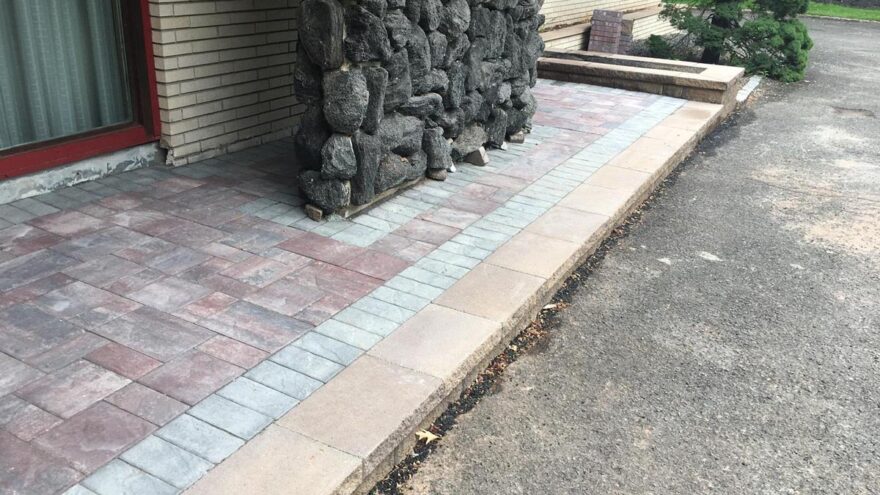
Choosing a patio material sounds simple until you start looking at options. Pavers look sharp and come in endless patterns. Stamped concrete can mimic stone for less. Natural stone has that high end, one of a kind look.
But the best choice is not only about looks. It is about how the patio will handle weather, foot traffic, furniture, grills, and the way your yard drains. A patio that looks great on day one can feel annoying if it cracks, sinks, grows weeds between joints, or gets slippery after rain.
This guide compares three popular options in a clear way: pavers vs stamped concrete vs natural stone. You will see realistic price ranges, pros and cons, maintenance needs, and simple examples to help you decide.
Quick comparison (simple and honest)
If you want easy repairs and flexibility: pavers usually win.
If you want a smooth surface and lower joint maintenance: stamped concrete is often attractive.
If you want the most premium look and true uniqueness: natural stone is hard to beat.
Cost wise, there is overlap, but here are common installed ranges:
- Paver patio: about $8 to $25 per sq ft
- Stamped concrete patio: about $8 to $28 per sq ft
- Natural stone patio (flagstone and similar): about $11 to $30 per sq ft
Your actual price depends heavily on base prep, site access, patio shape, and finishes.
Option 1: Pavers (concrete pavers)
What it is
A paver patio is built from individual units laid on a compacted gravel base with a sand bedding layer. Joints are filled with sand (often polymeric sand).
Typical cost
Angi lists paver patio installation around $8 to $25 per sq ft depending on size, materials, and complexity.
Best reasons to choose pavers
1) Repairs are usually easier
If a section settles or gets stained, you can often lift and reset pavers in that area rather than tearing out the entire patio.
2) Great for freeze and thaw movement
Because pavers are individual units, the system can handle minor movement better than a single slab in many climates. (The key is still a proper base.)
3) Lots of style options
You can do clean modern layouts, traditional patterns, borders, and inlays.
4) You can control weeds with the right joint material
Better Homes and Gardens notes polymeric sand can help prevent weeds and can last 8 to 10 years before it may need refreshing.
Downsides to know
1) Joint maintenance is real
Over time, joints may need topping up, especially if pressure washing removes sand.
2) A weak base leads to settling
Pavers do not “hide” base problems. If the base is thin or not compacted well, you may see uneven areas.
3) Edges must be restrained
Without proper edge restraints, pavers can spread slightly over time.
Best fit for pavers
- Patios where you want long term flexibility and the ability to fix small sections
- Homes with tree roots nearby (pavers can be adjusted if needed)
- Spaces where you like a textured, non slippery feel
Option 2: Stamped concrete
What it is
Stamped concrete is a poured concrete slab that is patterned and colored to look like stone, brick, or tile. It is usually finished with a sealer to enhance color and help protect the surface.
Typical cost
HomeAdvisor lists stamped concrete at $8 to $28 per sq ft, depending on design complexity and coloring.
Best reasons to choose stamped concrete
1) A smooth, continuous surface
Great for moving furniture, rolling carts, and a clean look without joints.
2) Strong design impact for the price
Stamped concrete can mimic higher end materials while staying in a mid range budget.
3) Lower joint maintenance
You do not have paver joints to re sand or manage.
Downsides to know
1) Cracking can happen
Better Homes and Gardens points out stamped concrete can crack, especially in freeze thaw climates, and repairs can be hard to blend because the pattern and color are difficult to match.
2) Repairs are not “spot friendly”
A paver can be swapped. A slab repair often shows.
3) Resealing is part of ownership
To keep color and reduce staining, resealing is commonly recommended over time (frequency depends on traffic and exposure).
Best fit for stamped concrete
- Clean, modern patios where you want one smooth surface
- Large open areas where pattern continuity looks great
- Properties where you want a strong look without stepping into natural stone pricing
Option 3: Natural stone (flagstone, bluestone, granite, limestone)
What it is
Natural stone patios use real quarried stone, either cut into consistent shapes or installed as irregular flagstone. Every piece has natural color variation and texture.
Typical cost
HomeAdvisor lists sandstone and flagstone pavers at about $11 to $30 per sq ft installed (cost varies by stone type and labor).
Best reasons to choose natural stone
1) True premium look
Natural variation makes it feel high end without looking “manufactured.”
2) Long term durability when you pick the right stone
Dense stones like bluestone and granite tend to perform well, but stone choice matters.
3) Adds a “finished” feel to landscaping
Stone often pairs beautifully with steps, walkways, and masonry features.
Downsides to know
1) Not all stone behaves the same outdoors
The Natural Stone Institute notes that stone properties can vary significantly and that climatic conditions like freeze thaw cycles should be considered when selecting stone.
2) Freeze thaw risk depends on the stone and installation
ASTM highlights that standards and test methods use freezing and thawing (including in salt water) to evaluate the impact on natural stone.
In plain terms: some stone handles winter better than others, and the wrong stone in the wrong setting can spall or flake.
3) Higher labor and heavier material
Irregular flagstone can be more time consuming to install well, which pushes cost.
4) Sealing may be needed
Some stones benefit from sealing to reduce staining and moisture absorption, especially in wet areas.
Best fit for natural stone
- Front or backyard patios where you want the most premium finish
- Homes where stone matches existing masonry or high end exterior design
- Clients who are okay paying more upfront for uniqueness
Simple cost example (so you can visualize it)
Let’s say you want a 12 ft x 16 ft patio (192 sq ft).
Using the common installed ranges:
- Pavers: 192 x $8 to $25 = $1,536 to $4,800
- Stamped concrete: 192 x $8 to $28 = $1,536 to $5,376
- Natural stone: 192 x $11 to $30 = $2,112 to $5,760
These are material plus install ranges. Site access, excavation, drainage fixes, steps, and borders can move the total up.
How to choose the right material (use these 6 questions)
1) Do you get puddles after rain?
If yes, drainage and pitch matter more than the material. Fixing water flow often extends the life of any patio.
2) Do you have freeze thaw concerns?
If you are in a region with winter freeze thaw, you want:
- a well compacted base for pavers
- proper concrete mix and control joints for stamped concrete
- the right stone selection and installation details for natural stone
3) Do you want easy future repairs?
If you want the easiest “fix one area” approach, pavers are usually the friendliest option.
4) Do you hate weeds and joint maintenance?
Stamped concrete reduces joint maintenance. With pavers, polymeric sand helps, and Better Homes and Gardens notes it can help prevent weeds and last 8 to 10 years.
5) Is this a furniture heavy patio?
If you will move furniture often or want smooth rolling, stamped concrete is easiest. Pavers can be smooth too, but joints are still joints.
6) Do you want the most premium look?
Natural stone wins for uniqueness, but it requires smart selection and good installation.
Contractor checklist (this matters more than the material)
No matter what you choose, poor installation is what causes most regrets. Ask your contractor:
- How deep will you excavate, and how thick is the base?
- How will you handle drainage and pitch away from the home?
- What is your compaction process?
- For pavers: what edge restraints and joint sand will you use?
- For stamped concrete: where will control joints go, and what sealer is included?
- For natural stone: what stone type do you recommend for this climate and why?
If the answers are vague, that is a warning sign. Good paving contractors explain the “why” clearly.
Final thoughts
Pavers, stamped concrete, and natural stone can all create a beautiful patio. The smartest choice depends on your priorities:
- Choose pavers if you want flexibility, easier repairs, and lots of design options.
- Choose stamped concrete if you want a smooth surface and strong design impact, and you are okay with the risk that cracks can happen and repairs may be visible.
- Choose natural stone if you want the most premium look and you are willing to invest in the right stone selection and installation details for your climate.