
Article
Your front stoop takes more punishment than almost any other part of a Long Island home. It sits in full weather, gets soaked by roof runoff, and spends every winter under boots, shovels and rock salt. So when the steps start flaking, cracking or tilting, the question is simple: can this be fixed, or does it need to come out?
The honest answer depends on what is failing: the surface, a section, or the structure underneath. Here’s how to tell.
Why Long Island stoops break down
Most stoop damage traces back to water. Concrete is porous. Water soaks in, freezes, expands and pushes the surface apart, then thaws and repeats the cycle all winter.
Deicing salt makes it worse. Industry guidance from the National Ready Mixed Concrete Association (CIP 2) explains that freeze-thaw cycles in the presence of deicers are a major cause of scaling, and that ammonium sulfate or ammonium nitrate deicers can chemically attack concrete. A guidance sheet from the Pennsylvania Aggregates and Concrete Association goes further: no deicer should be used on concrete that has not fully cured.
The other big cause is settlement. Many older stoops were poured on fill soil that compacts over time. When the soil below moves, the stoop tilts or pulls away from the house.
Start here: the symptom checklist
Walk out front and compare what you see with this table.
| What you see | What it usually means | Typical verdict |
| Thin flaking on the surface, solid underneath | Surface scaling | Repair or resurface |
| One or two hairline cracks, nothing moving | Shrinkage or minor stress | Repair (seal the cracks) |
| A chipped or broken step edge | Impact or localized freeze damage | Repair |
| Widespread crumbling, exposed stone, steel showing | Deep deterioration | Replace |
| Stoop tilting, sinking, or gap at the house wall | Settlement or failed base | Replace (often with base work) |
| Rust stains or concrete popping off over steel | Corroding reinforcement | Replace or major rebuild |
| Uneven step heights that trip people | Settlement or poor original build | Replace |
That table is a starting point, not a diagnosis. A contractor should confirm by checking whether the concrete sounds hollow when tapped and whether the stoop has moved relative to the house.
When repair makes sense
Repair is the right call when the structure is sound and the damage is local. Typical fixes include:
- Patching chipped corners and nosings with a bonded repair mortar
- Routing and sealing stable cracks so water stops getting in
- Resetting loose caps, treads or veneer pieces on a masonry stoop
- Repointing failed mortar joints on brick or stone steps
Well-done repairs can buy years of life. But a patch is only as good as what it’s bonded to. Patching over soft, crumbling concrete usually fails within a winter or two.
When resurfacing makes sense
Resurfacing sits in the middle. If the whole surface is scaled but the stoop is level, solid and the right shape, a thin bonded overlay can give it a uniform new face.
It’s a cosmetic and protective fix, though. It will not correct a tilt, fill a void under the slab, or stop corroding steel. If you’re looking at resurfacing because the stoop “just looks old,” make sure someone has checked for movement first.
When replacement is the better investment
Replacement is usually the smarter money when:
- The stoop has moved: it slopes toward the house, has dropped, or has opened a gap at the foundation.
- Deterioration is widespread, not limited to the top layer.
- Steel reinforcement is rusting and expanding.
- Step heights are uneven enough to be a trip hazard.
- You’ve already repaired it more than once and the damage keeps coming back.
A stoop pulling away from the house also deserves a look at the foundation and drainage around it. Water directed toward the foundation can show up later as basement moisture.
Codes and permits on Long Island
New steps are new construction, so they need to follow the current state code. New York’s 2025 Uniform Code, including the 2025 Residential Code of New York State, took effect on December 31, 2025. It covers things like stair riser and tread dimensions, landings and handrails. The full text is free to read on the ICC’s New York codes page.
Permit rules vary between towns and villages in Nassau and Suffolk. Check with your local building department before work starts, or ask your contractor to confirm what’s required for your address.
Choosing the material for a new stoop
If you’re rebuilding, you also get to rethink the look. Options include:
- Poured concrete: practical and cost-effective; can be finished with a broom texture for grip.
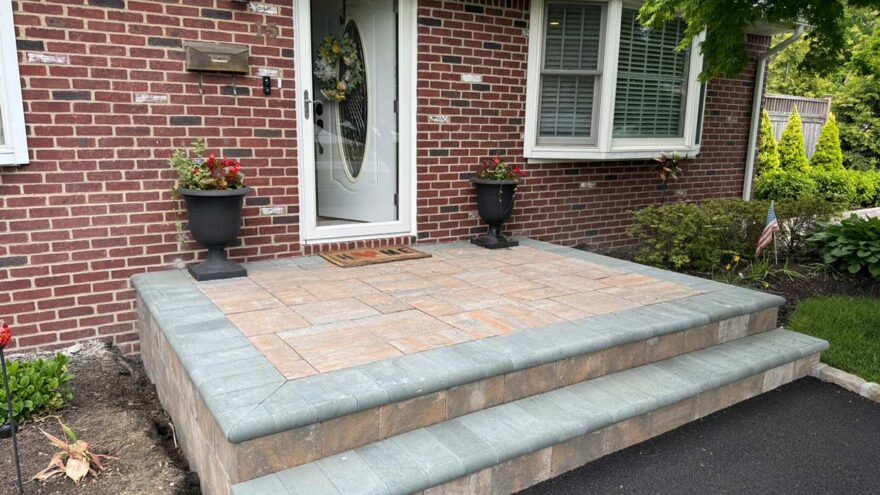
- Pavers or wall block (such as the Cambridge pavers many Long Island homes use): modular, easier to repair section by section.
- Natural stone or bluestone treads on a masonry base: a premium, traditional look.
- Brick: classic on older homes, but joints need maintenance.
Whatever you choose, ask how the new stoop will shed water away from the house and what surface texture it will have for icy mornings.
Protecting the stoop you have (or the new one)
- Use sand or a deicer labeled safe for concrete, and never use ammonium-based fertilizers as ice melt.
- Shovel promptly so meltwater doesn’t refreeze on the steps.
- Make sure gutters and downspouts don’t dump water onto the stoop.
Seal small cracks before winter.
Get a straight answer on your steps
Armorproof repairs and rebuilds front stoops across Nassau and Suffolk County through our step installation and concrete repair services. If your steps are brick or stone, our guide to signs your brickwork needs professional masonry repair is worth a read too.
Book a free estimate and we’ll tell you honestly whether your stoop needs a repair, a resurface, or a rebuild.
FAQs
Can I just pour new concrete over my old front steps?
Only if the existing stoop is solid, level and hasn’t moved, and only with a proper bonded overlay. Pouring over a settling or crumbling stoop hides the problem rather than fixing it.
Does salt really damage concrete steps?
It can. Deicers worsen freeze-thaw scaling, and ammonium-based products can attack concrete chemically. Keep deicers off concrete that hasn’t fully cured, and use products labeled safe for concrete.