
Article
TL;DR: Belgian block driveway edging gives an asphalt or paver driveway a clean granite border that protects the edges from crumbling and keeps tires off the lawn. On Long Island, the decisions that matter most are flush vs raised height, how the blocks are set, and doing the work at the same time as repaving.
Walk any older street in Nassau or Suffolk and you’ll see it: a driveway whose asphalt edges have slowly broken off into the lawn, leaving a ragged line of loose stone and tire ruts. Belgian block edging is the classic Long Island fix. It also changes how a driveway looks more than almost any other upgrade for the money.
This guide walks through the choices you’ll face, in the order you’ll face them, so you can talk to a contractor knowing what you want.
What Belgian block actually is
Belgian block is the common name for cut granite cobblestones. This Old House describes three standard sizes (regular, jumbo and cube) and four common colors: gray, pink, black and tan.
Because it is natural granite rather than molded concrete, it doesn’t fade the way some dyed products can. It looks right next to black asphalt, and it suits most Long Island architecture, from Cape Cods to colonials.
Regular blocks are the usual choice for edging. Cubes are better as infill or decorative bands.
Why Long Island driveways benefit from a hard edge
Asphalt is strongest in the middle and weakest at the edges, where nothing holds it in place. Every time a tire rolls near the edge, the material is pushed outward. Add a few freeze-thaw winters and you get the crumbling border most homeowners recognize.
A properly set Belgian block border acts as a restraint. It holds the asphalt in, gives the driveway a crisp line, and stops cars from cutting the corner onto the grass. It also keeps mulch and soil from washing onto the surface during heavy rain.
If your edges are already failing, read our guide on asphalt driveway repair: patch, resurface, or replace first. Edging works best on a sound driveway, not a failing one.
Decision 1: Flush or raised?
This is the choice people most often regret getting wrong.
- Flush (set level with the driveway): Water sheets off freely, and snow plows and shovels glide over it. Most homeowners who plow or use a plow service choose this.
- Raised (sitting above the surface, like a curb): Gives a stronger visual line and physically stops cars rolling onto the lawn. The trade-off: it can trap water along the edge and catch a plow blade.
A common middle ground is flush along the length of the driveway with a slightly raised section where you need a hard stop, such as beside a planting bed. Before deciding, think about where water goes now during a heavy storm. A raised border should never block the path runoff already takes.
Decision 2: How the blocks are set
There are two broad methods, and they are not equal.
- Set in concrete. A trench is dug, and each block is bedded into a concrete footing and backed with concrete on the lawn side. Joints can be left tight or finished with mortar. This is the standard method for driveway borders that take vehicle traffic.
- Set in compacted gravel or sand. Cheaper and faster, but blocks can tip or sink over time, especially where tires hit them. It is better suited to garden beds than driveways.
Ask any contractor which method they use and how deep the footing goes. If the answer is vague, keep asking.
Decision 3: Single row, double row, or an apron
A single row along each side is the most common layout. A double row reads as more substantial on wide or long driveways.
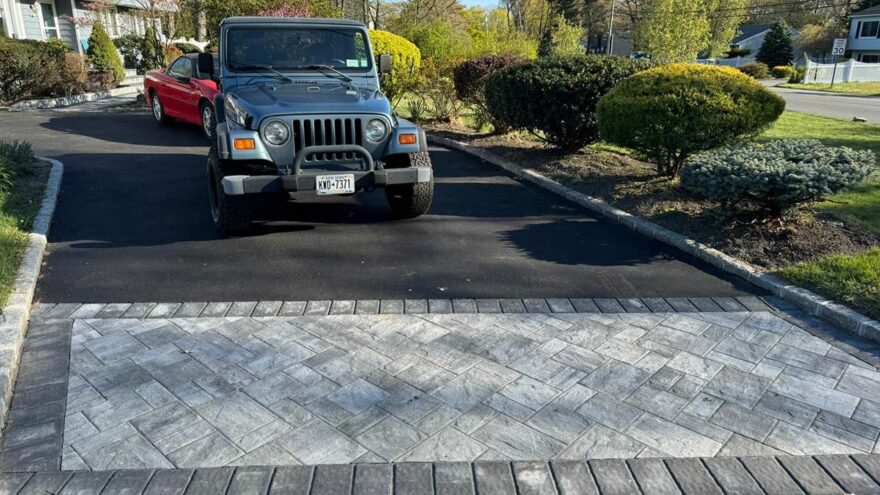
Many Long Island homeowners also use Belgian block where the driveway meets the street. A Belgian block apron or a band across the entrance frames the driveway and protects the section that takes the hardest turning loads. We cover that zone in more detail in driveway apron repair on Long Island. Note that work touching the street or curb may need approval from your town or village, so check before planning it.
Decision 4: When to install it
The best time is during a driveway replacement. The old edge is already removed, the base can be prepared properly, and the new asphalt can be compacted tight against the blocks. That tight joint is what keeps water out.
Adding edging to an existing driveway is possible, but the contractor has to saw-cut a clean line in the old asphalt. If that asphalt is near the end of its life, you may end up paying for edging twice. Concrete also needs warm enough weather to cure properly, so most projects are scheduled from spring through fall.
Common mistakes to avoid
- Setting the blocks higher than the planned asphalt height, so water ponds along the edge.
- Skipping the concrete backing on the lawn side, which lets blocks lean outward.
- Mixing block colors from different batches without checking them side by side.
- Installing edging on asphalt that should really be replaced.
- Forgetting the plow: a raised border needs a plan for winter snow removal.
- Ignoring the apron, which usually takes more abuse than the sides.
Belgian block vs other edging options
Concrete pavers and brick are common alternatives and offer more colors. Poured concrete curbing is often cheaper. Belgian block’s advantage is that it is solid granite, so it stands up well to tires and weather and still looks good decades on. Cost depends on driveway length, the layout you choose and site conditions, so the only reliable figure is a site-specific estimate.
Planning your project with Armorproof
Armorproof installs Belgian block borders and aprons as part of our driveway paving work across Nassau and Suffolk County. See examples of finished driveways in our project gallery.
If you’re planning to repave in the next year or two, now is the right time to decide on edging. Request a free estimate and we’ll walk the driveway with you, check drainage, and recommend a flush or raised layout that suits how you use it.
FAQs
Can Belgian block be added to an existing asphalt driveway?
Yes. The contractor saw-cuts a straight line along the edge, digs a trench and sets the blocks in concrete. It makes most sense if the asphalt still has years of life left.
Will Belgian block edging get damaged by a snow plow?
Flush-set blocks rarely cause problems because the blade rides over them. Raised borders are more likely to be caught, so tell your plow service where they are.